GEODE OR ROCK
Geodes typically have a round or oblong shape with a bumpy or lumpy surface. They are often lighter in weight compared to solid rocks of similar size. Additionally, some geodes may exhibit a slight translucency, allowing you to see hints of the crystal formations inside.
GEODES
Geodes are spherical or egg-shaped rocks containing a hollow cavity which is lined with crystals. They form in both igneous and sedimentary rocks. There are two major steps in their formation. STEP 1 – A hollow cavity is formed in the rock. STEP 2 – Minerals are deposited on the walls of the cavity.
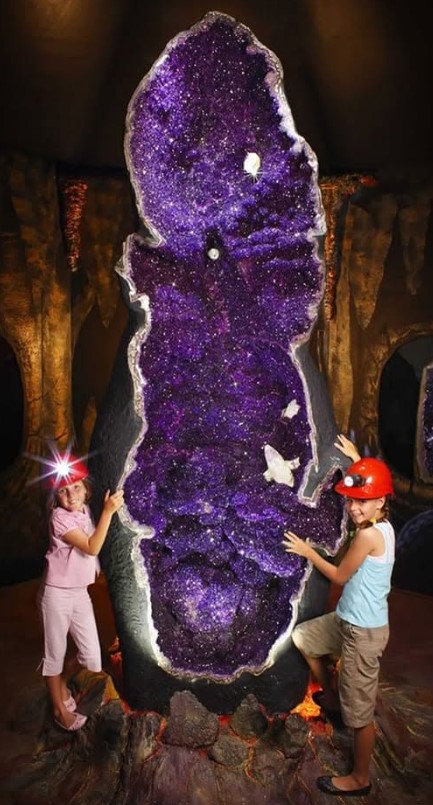
Most geodes contain clear quartz crystals, while others have purple amethyst crystals. Still others can have agate, chalcedony, jasper banding or crystals such as calcite, dolomite, celestite, etc. There is no easy way of telling what the inside of a geode holds until it is cut open or broken apart.
Geodes are found only in places that have the right conditions to create them. You’re most likely to find geode rocks in deserts, volcanic ash beds, or places with a lot of limestone. Countries that have plentiful geodes include the United States, Mexico, India, Brazil, Madagascar, Namibia, and Uruguay.
VOLCANIC GEODES
The most widely known and sought-after geodes are those that formed in areas of volcanic activity. Voids in basaltic lava flows often are infilled with agate, quartz, opal and other material delivered by hydrothermal water or groundwater. Some voids are spaces occupied by gases that failed to escape the lava flow before its surface crusted over.
Where does all of the gas come from? Some magmas contain a lot of dissolved gas. They can be several percent dissolved gas on the basis of weight. (Think about that – several percent gas by weight!) When these magmas ascend to the surface, the gas expands in proportion to the pressure reduction. When the magma erupts as a lava flow, so much gas is released that not all of it is able to escape. Some of that gas can be trapped in the lava to produce a large cavity when the lava solidifies.
Other voids in solidified lava flows were produced as liquid lava flowed out after the flow was only partially solidified. These small “lava tubes” produce some of the largest and longest geodes. Many cathedral geodes are branches of these lava tubes that later infilled with mineral material. Many of them have the geometry of long tree branches, being nearly a meter in diameter and many meters in length.
SEDIMENTARY GEODES
Geodes in sedimentary rocks are usually found in limestones, dolomites, and calcareous shale. In these deposits a gas-filled void can serve as the opening for geode formation. Shells, tree branches, roots and other organic materials often decay away to leave a void for the formation of mineral materials. These cavities can be filled with quartz, opal, agate or carbonate minerals. They are generally smaller than the geodes formed in volcanic rocks.
Geodes are most easily collected when their host rocks have weathered away. This can occur because basalt, limestones, dolomites, and shales weather much more readily and rapidly than the quartz and chalcedony that typically form the outer layer of a geode. The host rock weathers away and the geodes are left on the surface, washed into a stream, or stranded in a residual soil. In these situations the geodes are easily found and collected. Some geodes are produced by mining the host rock, but that method is difficult, costly, and often damages the geode.
GEODES AROUND THE WORLD
- Brazil & Uruguay: Known globally for immense “Amethyst Cathedrals”. These large geodes feature thick layers of dark purple quartz and agate.
- Mexico: Famous for “Las Hoyas” in Chihuahua, which produces geodes with varied quartz and unique calcite formations.
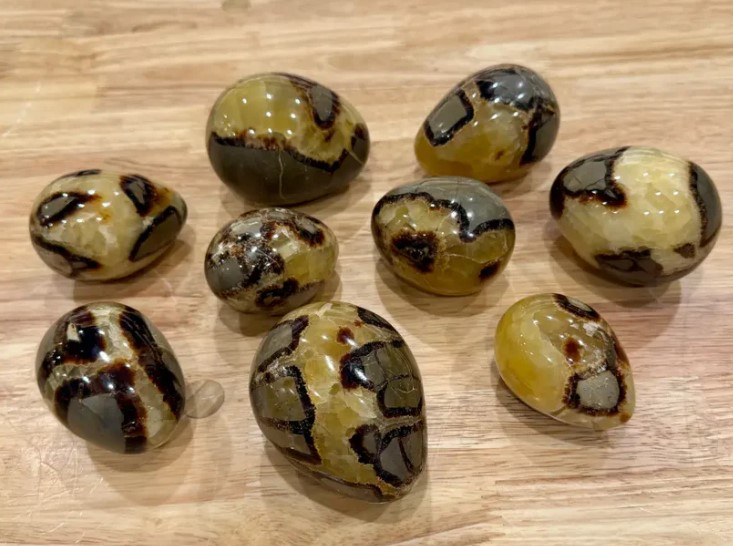
- Madagascar: Yields exquisite, large celestite (sky-blue crystals) and Septarian “Dragon Eggs”.
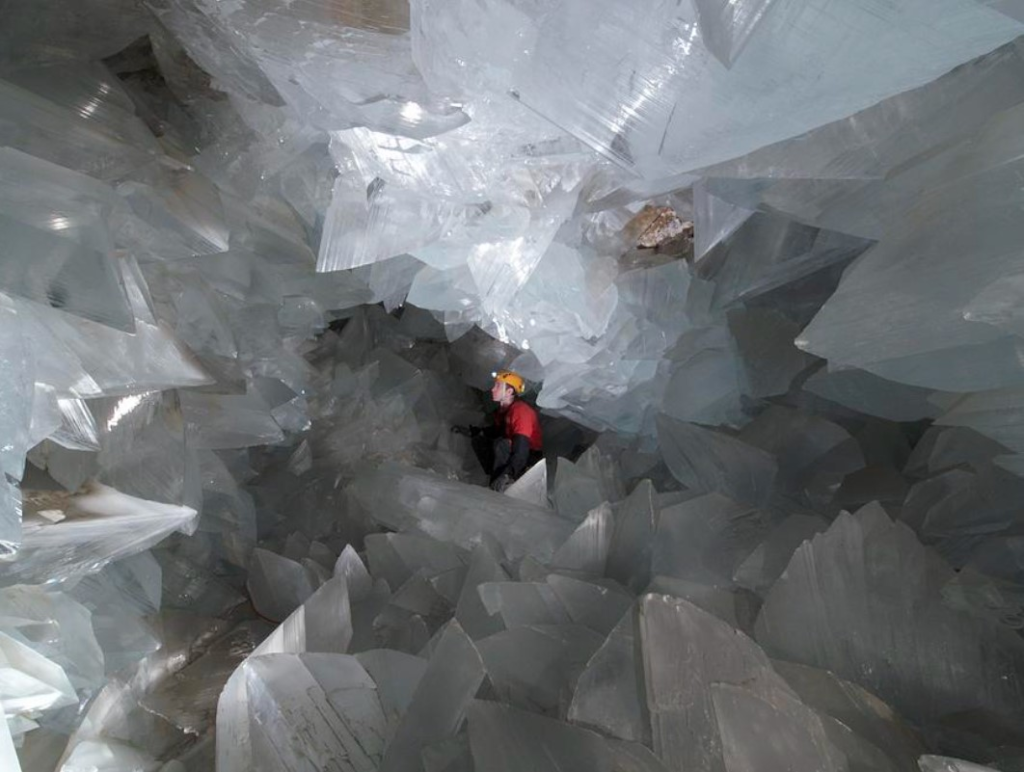
- Spain: Home to the giant Pulpí Geode, a 26-foot chamber that is one of the largest in the world.
- Namibia: Known for producing high-quality amethyst geodes lined with contrasting minerals. |
- Iowa/Illinois/Missouri (Keokuk Area): Famous for geodes with quartz interiors, pink calcite, and sometimes rare minerals like millerite.
- Utah (Dugway Geode Beds): Western Utah is a highly popular destination for finding quartz and topaz geodes.
- California (Hauser Geode Beds): Located in the Imperial Valley, these beds are a prime destination for rockhounding.
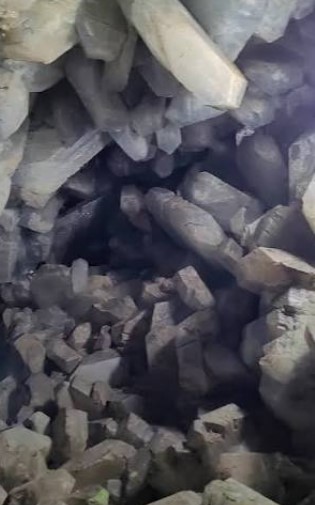
- Ohio (Put-in-Bay): Home to Crystal Cave, an underground geode cavity that is large enough to fit inside and is completely lined with massive tabular celestine crystals.
RESOURCES … Formation of Geodes / Common Minerals Found in Geodes / Breaking Open a Geode / Amazing Geode Formations / Geodes / Bita Bird / Comparing Geodes (Sedimentary vs Igneous) / The Beauty Within
GEODE OR ROCK
1a. Determine if the large tan item is a rock or a geode. Explain what characteristics led you to your decision.
1b. Determine if the smaller brown item is a rock or a geode. Explain what characteristics led you to your decision.
GEODE LAB
In the ammo can, there is a small geode to break and see what is inside. Place the geode in the sock. Tap with the hammer to break. Empty the sock.
2a. Based on your observations, is your geode sedimentary or volcanic?
2b. Why are there no metamorphic geodes?
2c. Describe what was inside your geode.
2d. Identify what mineral (if any) lined the inside of the rock. See resources if needed.
2e. Take a picture of what was inside your geode.
GEODE QUIZ
3. Only four of the following statements are false. Which are they?
1. The term geode is derived from the Greek word Geoides which means “earthlike.”
2. A geode is a sphere-shaped rock which contains a hollow cavity lined with crystals.
3. The rough exterior of the geode gives an indication of the secrets held within its core.
4. Geodes exhibit a wide range of sizes from inches in diameter to several feet. Most are less than a foot in width.
5. Geodes begin as bubbles in volcanic rock or as animal burrows, tree roots or mud balls in sedimentary rock.
6. Crystal Cave, located in Put-in-Bay Ohio, is the world’s largest geode and it is Ohio’s state rock.
7. Bitaba Birds are now extinct, but they did use geodes to line their nests.
8. The most common dissolved mineral is amethyst.
9. Different types of silica cool at varying temperatures, thus creating layers of different types of mineral crystals.
10. The only difference between a geode and a nodule is that a nodule has a hollow cavity, and a geode is solid.
AROUND THE WORLD
Using the places listed in the reading, determine where each of the following geodes were found.